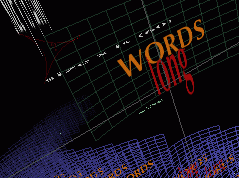
kinetext: Concrete Programming Paradigm for Kinetic Typography
|
| We present kinetext, a visual environment for programming text animations. Authoring any kind of animation involves a series of smaller decisions on movement, timing, and interplay of visual subject elements throughout the design process. While many authoring tools support this process, they fail to document it in such a way for others to easily discern the designer's decisions. Frequently the only artifacts are lengthy text programs or similarly oblique scores. kinetext presents an environment where authoring animation occurs via small visual programs that live over time. Each program illustrates each of the individual transformations responsible for the motion of each subject element in the animation. Viewed in its entirety, the environment becomes a sketchbook of the design process involved in bringing about the final animated piece. |
| kinetext is the result of research into the authoring process for dynamic typography in conjunction with computational design philosophy. Whereas the philosophy of conventional tools is to have the designer's intent, the tool, and the result exist as separate entities in the design process (see figure below), computational design philosophy creates a place where the tool and the result can coexist in the design process. This coexistence model then fosters an environment where intent can emerge. Essentially, an environment such as kinetext, enables an observer to see and understand the process from whence the result comes. In contrast, the conventional tool model separates the process from the result in such a way that an observer cannot necessarily see how the designer arrives at the result. |
![]() |
The goal of our system is to introduce a new paradigm to visual programming that provides the designer with a typographic authoring environment that illustrates the design process. Such an environment incorporates typographic operators with embedded visual characteristics and enables programs that can visually convey their functionality at a glance. The visual nature of the system is inspired by a spatially structured type of poetry known as "concrete poetry," where the arrangement of words take on form. Hence we refer to the system as a form of "concrete programming." |